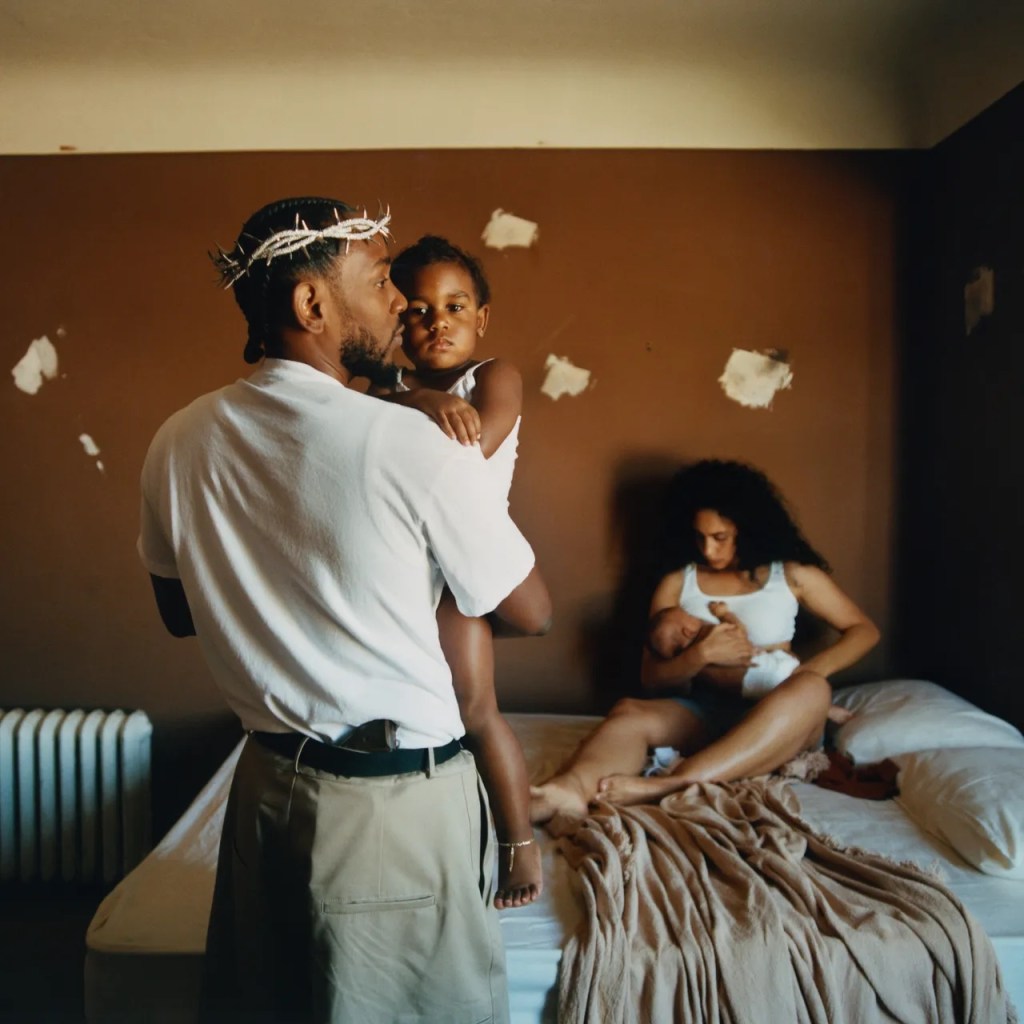
Kung-fu Kenny’s long anticipated return addresses how much he’s been tap-dancing around the trauma from his youth that’s leaked into every facet of his identity as a man. Hold your breath, we’re about to dive into some deep, heavy and murky waters.
‘I hope you find some peace of mind in this lifetime’ is the first line we hear on the project, and the rest of the tape shows the pitfalls in Kendrick’s journey to attain just that: peace. The first song depicts the vices Kendrick often falls back to whenever faced with dealing with grief. But as he’s a successful rapper, it means that he has more funds to facilitate his vices, and lists these as mainly being women and cars, to ensure his audience knows that he ‘grieves different’. However, this is a juxtaposition to the title of the song, ‘United in Grief.’ I think the sentiment here is that Kendrick recognises that although the amount of money he can use to cover up his grief is specific to him, the feelings from them are things that everyone goes through as part of the human experience, and are not unique to him at all. He cements this with the last line of the song being ‘everybody grieves different’.
The first disc of the double album, Mr Morale, focuses on his general perspective of things and if likened to painting, uses broad strokes to cover a lot of the topic area. It feels very general, and can thematically be mistaken as Kendrick’s previous attempts to address the world’s shared problems. This is even reflected in the language of some titles of the songs: ‘United in Grief,’ ‘Worldwide Steppers,’ ‘We Cry Together’. However, this is intentional by Kendrick, who inserts the sound of tap dancing at the beginning and end of some songs, playing on the idea that these general points are him dancing around his genuine personal struggles, and only touching on the surface level struggles that are somewhat shared. This theme is again supported by his partner Whitney (whose voice makes recurring appearances throughout) stating ‘stop tap-dancing around the conversation’ before the last song on Mr Morale, Purple Hearts.
The phrase Purple Hearts was coined after a medal that’s awarded to War Heroes and is often used to describe people who have survived through traumatic experiences. With Kendrick using it here, following on from a song about a troubled relationship, we can assume that he means to emphasise how he and his partner are both navigating their pasts and how it often affects how they form bonds with the people they care about. But they need to ‘shut the fuck up’ and stop combating their affection as a trauma response when they ‘hear love talking.’ Whitney’s voice through-out the project could also be the representation of ‘love’ itself, and that it’s Kendrick who needs to ‘shut the fuck up’ when she (love) is speaking to him. Like her suggesting he needs therapy on Father Time, her letting him know he is having a breakthrough on Count Me Out, and congratulating him at the end of the album (but more on that later).
‘One of these lives imma make things right with the wrongs I’ve done, that’s when I unite with the Father, Son, til then I fight.’ Those are the first words out of Kendrick’s mouth for the second disc, Big Steppers. Count Me Out is by far my favourite song on the album. It’s lyrically dense with several quotables, vulnerable in its approach, has cinematic backing vocals, and the beat switches between being triumphant and sombre. There are so many elements of the song that sounds like it is fighting against itself. The reverb on the guitar, the background vocals laying over each other, the (seemingly) random sounds of something remnant of an SOS beep… Every time you get used to the song as a listener, something else changes. Like as a challenge from me to you, listen to that song and try and count how long vocally, beat wise, adlibs wise, that it remains consistent. You will struggle.
I again think this is intentional by Kendrick to show him literally having to fight against himself and previous behaviours to have a ‘breakthrough’ like Whitney mentions. It could be interpreted as him telling the world that he loves when they count him out, but I disagree. In the song itself he only mentions other people as ‘they’, but every time he uses ‘you’ I believe he is addressing himself. He accentuates this further by saying ‘Ain’t nobody but the mirror looking for the fall off.’ So the idea of somebody counting him out is self-inflicted, and he is saying how much he loves disproving that negative version of himself. I’ve spoken baaarres about this song already, but can I just say that my favourite line from the song is ‘Where the bedroom at? Sleep I ain’t ever had affairs with that’, and it’s for its simplicity. When he is tired, he doesn’t cheat that feeling. He is loyal to sleep when his body desires it, but he is disloyal to his partner with the actions he takes in his bed, as adultery is a theme he touches on a lot on this project.
Which leads me onto the penultimate song from the album, Mother I Sober. This song for me is up there with Sing About Me, I’m Dying of Thirst, in terms of construction. I won’t go into too much detail here, because if you listen closely enough to the lyrics, you should understand most of it anyways. Kendrick layered this album every step of the way with different factors and elements of flaws that he not only recognises in himself, but in his community, and then used this song to provide deeper context into how some of these things came to be. Although he refutes the idea of being idolised as a savour throughout this album, he literally presents himself as sacrificial lamb for the betterment of his family and the wider listener, with Whitney proclaiming ‘You did it, I’m proud of you. You broke a generational curse.’ And this is where I take issue with the album.
To be clear, I think it is beautiful that Kendrick and his partner are able to feel like they are at the point where they have broken a generational curse. However, where I take issue is towards the climax of the tension he builds as he is setting ‘free’ the abusers in his/his families life, and then he says ‘As I set free all your abusers, this is transformation.’ Of course, some could argue that his statement there is only intended for his own trauma or the family members’ he mentioned, but due to him actually having the album riddled with an abuser in the form of Kodak Black throughout, it seems like he is making the wider sentiment that he is freeing a lot of listeners from the shackles of their abusers. Which I think is a bit odd. And if that isn’t the purpose, why is Kodak on the album?
On Savour he does say ‘(they) like it when they pro black, but I’m more like Kodak Black’, and I can only assume that means that he is flawed too like Kodak, but on an album that addresses heavy themes around sexual abuse it feels like a mis-step to have a convicted sexual abuser be apart of the delivery of that message. It could have been done in a better way, and so could recognising that he once had (as he himself declared) ignorant views on sexuality and identity, without actually saying fa**** several times on Auntie Diaries. The point here could be that the N word should be treated with as much scarcity and sensitivity as the F word, but I think those type of conversations should be had by those people within the communities that it is relevant to, and from what Kendrick has presented, he is not part of the LGBTQ+ community.
I say all of that to say, I still really enjoyed the album as a whole, and even the song with Kodak. And as much as some of the themes and choices, as I described above, confused me, I can appreciate him making the artistic choice to do something that wasn’t going to be completely liked by the masses and further push the agenda for those who at times (like myself) can feel like Kendrick takes the higher/more responsible moral ground on topics. With Mr Morale and the Big Steppers, and especially songs like N95 and Worldwide Steppers, Kendrick firmly denounces the idea of who his listeners think he is, and seemingly, who he thought he was too.

 QuoteKwame
wow!! 19After Some Time: Mr Morale and the Big Steppers by Kendrick Lamar (10 mins)
LikeLiked by 1 person